Categories
Presentations

Cataloging Wayfinding for Beginners (and Learners!)

I was delighted to be invited to develop this program for the New to Libraries Network. Although this was a challenging talk to pull together (and get posted in a timely manner!), I relished the opportunity to rethink my assumptions. My thanks and gratitude to the NLN crew: to Erin Kilkenny for moderating and to Cara Calabrese & Chloe Brown for the logistical support!

Abstract

Library workers find themselves cataloging for all sorts of reasons. For some, cataloging is simply one aspect of their position, while others chose to specialize in cataloging. Increasingly though, library leaders are reassigning cataloging responsibilities in response to staffing reductions, and the learning curve is steep. This webinar provides resources for anyone getting started (or restarted) with cataloging. A foundational premise for this webinar is the notion that “good enough” IS good enough and that levels of cataloging service may be tiered, granting busy library workers autonomy over finding what’s “good enough” to serve their library’s patrons.

After completing this webinar, participants will be able to:

  • Identify standards, best practices, and resources to aid in the creation of accurate and consistent bibliographic records.
  • Utilize professional networks and communication fora to find answers to difficult cataloging situations.
  • Articulate a tiered cataloging service that satisfies patrons’ needs and suits the resources available at your institution.
Slides
To view the speaker notes, click on the Notes tab.
Liss, Jennifer A. “Cataloging Wayfinding for Beginners (and Learners!)” New to Libraries Network Webinar, 15 April 2026, virtual. Invited Presentation. https://www.slideshare.net/slideshow/cataloging-wayfinding-for-beginners-and-learners/287252933
Resource listLiss, Jennifer A. Cataloging Wayfinding Resource List for Beginners and Learners. 15 April 2026. https://bit.ly/cataloging-wayfinding
Presentation recordingLiss, Jennifer A. “Competent Cataloging: Wayfinding for Beginners.” YouTube, uploaded by New to Libraries Network, 15 April 2026, https://www.youtube.com/watch?v=-NeQE6U07N0E.

Cataloging Wayfinding

The following work has been very lightly adapted from the April 15, 2026 presentation content to suit this online format.

Mapping the terrain

The following quote receives a lot of attention in the world of library information organization, its author being a chief architect of the dictionary-style catalog that remains the basis for library discovery systems today.

“Cataloging is an art.” — Charles Cutter

The full quote, “Cataloging is an art, not a science,” summarizes Cutter’s assertion that while cataloging rules stem from experience, no rules “can take the place of experience and good judgment” (Cutter 6). While a lovely sentiment, this lofty characterization of cataloging tends to conjure images of catalogers serenely working in ivory towers surrounded by walled gardens. (I’m still waiting for my walled garden.)

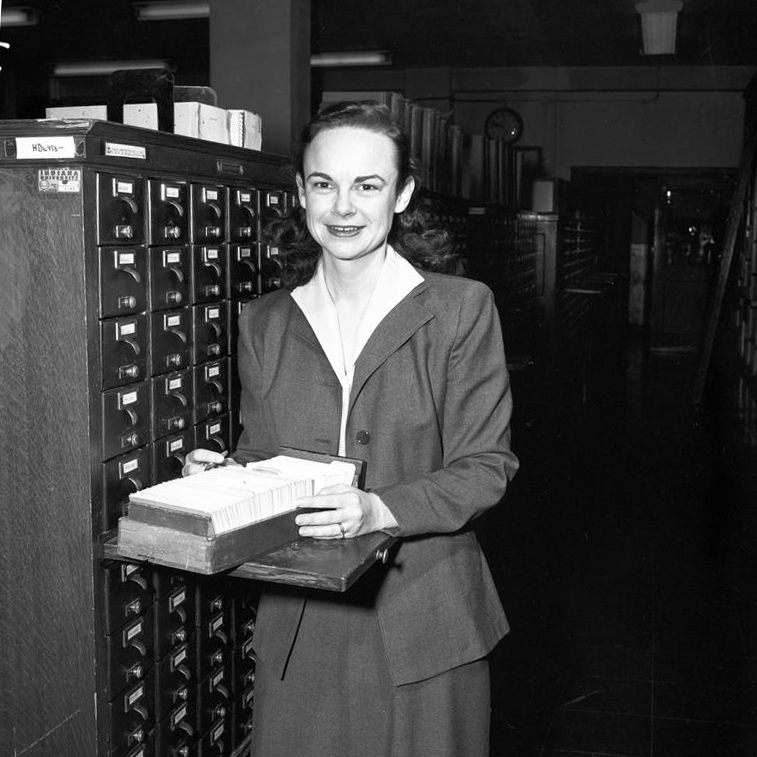
This characterization didn’t sit well with my cataloging mentor, Carl Horne of Indiana University, either. Carl revised Cutter’s quote, offering:

“Cataloging is a craft.”

As someone who’s been privileged to work among the most skilled and experienced catalogers in North America, I see many parallels between medieval-era craft guilds and modern cooperative cataloging operations. Artisans, much like catalogers, learn their craft through apprenticeships and then spend their entire careers practicing and honing their craft. To be a member of the “guild” you must put in time and do the hard work; there are simply no shortcuts to learning any craft.

Well, that sounds lovely for the cataloger who works at an institution that supports career-long craft making! What about the rest of us?

I can only imagine the reasons the reasons that brought you to this presentation. I imagine some may be graduate students. Maybe some of us are looking for a career change. Some of us may have been informed that we’re now responsible for managing catalog records on top of the many other things we must do. Some of us have neither the time nor perhaps even the desire to learn the craft of cataloging. The good news for all of us, is that maybe–

Cataloging is a task.

To be sure, cataloging is a complex task, with a lot of parts to it; but it’s a task, nonetheless.
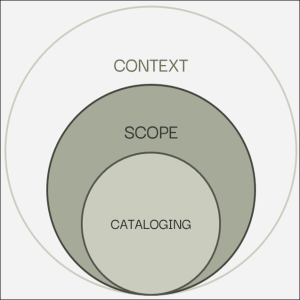
A Euler diagram illustrating how cataloging exists within a scope, and how both cataloging and scope exist within a context.

Here is the premise of this talk: Tasks have a scope and tasks are completed in specific context. This means that tasks can be right sized for the resources that are available. If a task can be right sized, then cataloging can be right sized. When we know how much cataloging we can afford, we can better prioritize our cataloging training to meet the immediate needs of our library’s patrons.

In this presentation, I’ll briefly cover:

  1. Why we catalog.
  2. The notion of right-sizing our cataloging (and therefore our cataloging training) to satisfy the level of cataloging that our institution can afford.
  3. Cataloging information that I wish I’d known when I was starting out.
  4. Resources for those who are brand new to cataloging and those who are familiar with but perhaps want to learn a bit more about cataloging.

When you leave this session today, I hope you have one or more concrete actions that you might take right away, plus one or two longer-term goals in mind.

I’m Jennifer Liss, and I’m Head of Cataloging at Indiana University Bloomington Libraries. I began learning the cataloging craft 20 years ago, right out of library school. Since then, I’ve completed a lot of cataloging training (one never stops, really), became a project manager, and then a cataloging team leader. Now, as a department head, I suppose you can say that I lead the guild. (I’ll try not to mangle this metaphor any further!) I’m excited to learn from all of you.

Why catalog?

Imagine walking into your grocery store to pick up some drinks, only to find that every item in the beverage aisle was missing its label.

Cataloging saves the time of the user.

It’s not difficult to imagine how important metadata is, nor how much time it saves people. Libraries do not save patrons’ time by mere chance or accident. Nor is it an accident that books on the same topic or written by the same fiction author are located together on a shelf. My least favorite phrase used in library circles is “serendipitous discovery.” Discovery and access are possible thanks to the labor of folks who selected, ordered, cataloged, processed, and shelved the item, not a magic wand. The resource list I will share at the conclusion of this talk will include several resources to learn more about the “why” of cataloging.

Right-sized Cataloging

Finding the threshold of “just enough” cataloging.

The bulk of my presentation will focus on this question of knowing how much cataloging is needed & possible; and then determining how much cataloging training is required to meet that need. Whether you’re new to your institution or not, it is good to do this high-level reflection occasionally, as circumstance change.

Let’s go back to the Euler diagram I shared, which illustrates how cataloging exists within a scope and context.

Context informs scope, which in turn informs cataloging decisions.
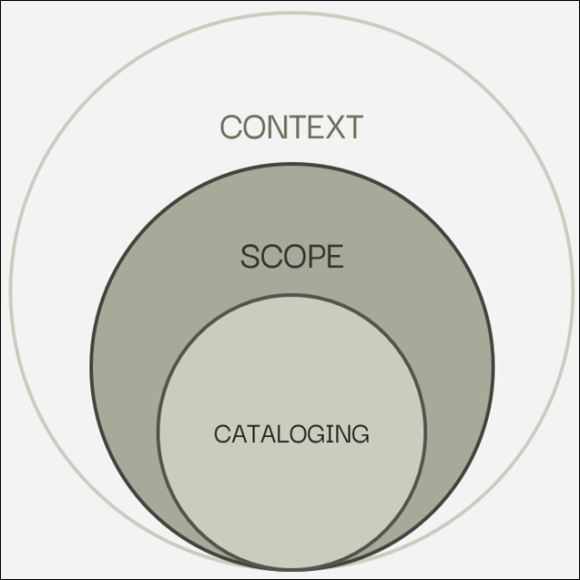
A Euler diagram illustrating how cataloging exists within a scope, and how both cataloging and scope exist within a context.

Context: library type, patron needs, available resources

Scope local decisions concerning the extent of cataloging to be attempted

Cataloging context

Cataloging context accounts for the local environment you work within.

The type of library is a major factor to consider in right-sizing cataloging. For example, I work at a very large academic library that supports doctoral and post-doctoral research. The core operating assumptions of a large research library are quite different than those of the public library just up the street. Library type heavily influences the characteristics of a library collection. The local public library may buy a dozen print copies of the latest James Patterson novel, while the nearby research library has zero copies of the same Patterson novel but is taking great pains to conserve a 10-volume set on Roman archeology published 150 years ago. Regardless of library type, all libraries have special or distinctive collections to consider. A public library might have unique genealogical files and resources, collected from the community.

When considering patrons needs, think about a typical patron. Yes, it may be true that our library “super” users comprise less that 20% of the total patron population served and yet seem to consume 80% of our time. Make sure the “common good” is served first, before striving to serve those super users. The needs of your library patrons may be inferred from the type of library you work at, however, each context is different and constantly evolving. For instance, a growing Spanish-speaking population might introduce new user needs.

Resources—budget and staffing—are of course a huge factor in right-sizing cataloging. Knowing a little about how your library’s budget is structured may help you identify alternative revenue streams. Is there a cash fund? At academic libraries, we commonly see postings for temporary or “visiting” positions that last 2-3 years, often to help address a finite cataloging backlog. A large gift or grant-based project might be written to include the cost of cataloging. Talk to your leaders. Temporary funding may be available for backlogs or strategic priorities.

Finally, any combination of library, type, patron needs, and available resources will have influenced how the library has handled cataloging. Many libraries have automated acquisitions and cataloging work by opting for shelf-ready services from vendors. Some libraries import all or part of the catalog records they need into their library catalog in batches, instead of importing and editing catalog records one-by-one. These arrangements can help catalogers focus on unique items that need cataloging attention.

Cataloging scope

Cataloging scope refers to intentional decisions (local policies or practices) made about how much cataloging will be attempted.

Here I’ve included two types of resources that could be found at a public library.
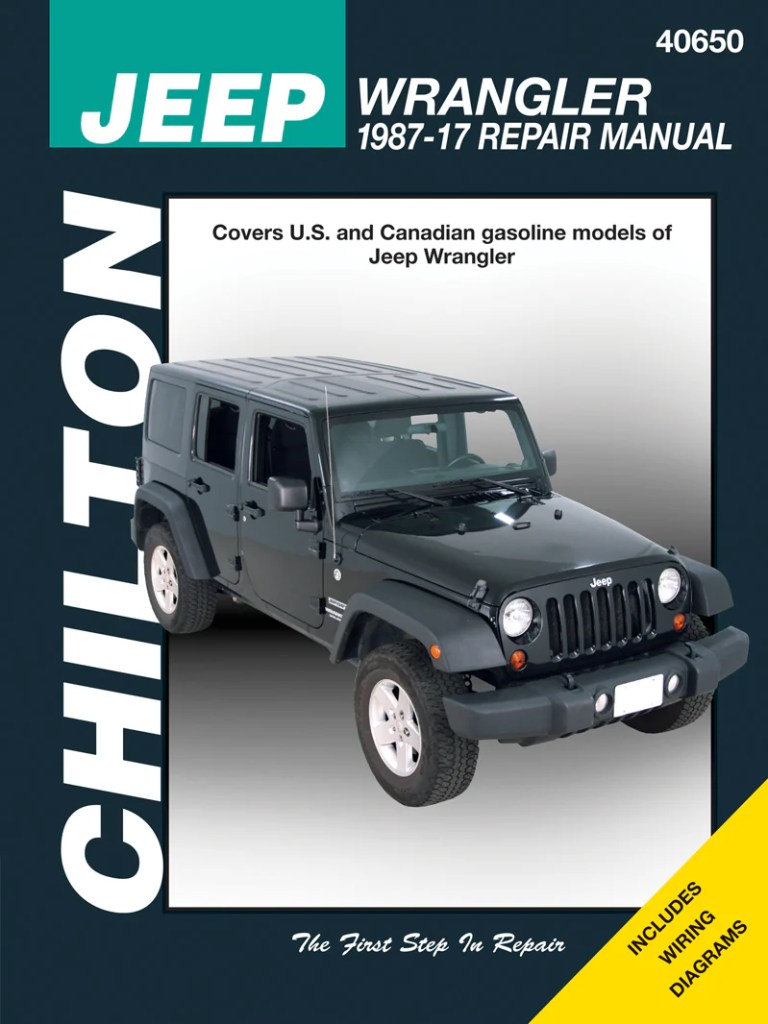
One is a Chilton repair manual, a mass-published resource that may be so highly used that it must be replaced periodically. Public libraries also collect unique resources, such as items donated by the community to be added to the genealogical collection. A library’s cataloging service may need to support both the general collections (i.e., the Chilton repair manual) and special collections (i.e., a collection of early 20th century scrapbooks from a notable local resident).

It’s generally assumed that library catalogs must support known item-searching, or catalog searches for a specific resource. Many patrons type the names of titles or authors or ISBNs into a library catalog search box and expect to see the resource returned in the results list.

It is incredibly frustrating for catalog users (and librarians!) when a search for a known item fails.

Patrons know that their public library has the latest Patterson novel, so why isn’t a catalog record appearing in the search results list?

Supporting known-item searching

Following is a snippet of an undergraduate English literature syllabus I found on the web. Highlighted are elements such as title, author, ISBN, publisher, and year publication.

Required Textbooks & Materials
A note on texts: Please attempt to get the editions listed here, so that we do not struggle to get ourselves on the same pages during class discussion.

William Shakespeare, As You Like It, Arden edition ISBN: 9781904271222

Jane Austen, Sense and Sensibility, ed. Ros Ballaster, (Penguin, 2004) ISBN 978-0141439662

The following Norton Anthology volumes must be the Tenth (and only the Tenth) edition:

Norton Anthology of English Literature (10th edition), Volume C: The Restoration and Eighteenth Century, ed. James Noggle (2018) ISBN 978-0-393-60304-0

Descriptive cataloging elements such as title of a book, date of publication, and the like, are commonly shared via the places that people are likely to hear about new books or movies or music, for instance Oprah’s book club, an email from Goodreads or LibraryThing listing books your friends are reading, a podcast, etc. Such descriptive elements are crucial for supporting known-item searches in library catalogs.

Notice too that this syllabus, for reasons the instructor explains, is asking that students use very specific versions of these resources. Not any version of As You Like It will do; the instructor wants students to read the Arden edition.

Required Textbooks & Materials
A note on texts: Please attempt to get the editions listed here, so that we do not struggle to get ourselves on the same pages during class discussion.

William Shakespeare, As You Like It, Arden edition ISBN: 9781904271222

Jane Austen, Sense and Sensibility, ed. Ros Ballaster, (Penguin, 2004) ISBN 978-0141439662

The following Norton Anthology volumes must be the Tenth (and only the Tenth) edition:

Norton Anthology of English Literature (10th edition), Volume C: The Restoration and Eighteenth Century, ed. James Noggle (2018) ISBN 978-0-393-60304-0

Here you might see how one might think through the minimum descriptive cataloging elements required to support discovery in the library catalog. In fact, the cataloging profession has thought about this quite a lot.

Minimal-level cataloging

The cataloging standards MARC21, AACR2, and RDA recommend the following descriptive cataloging elements for minimal-level cataloging:

  • Title
  • Statement of responsibility
  • Edition
  • Materials (type of publication)
  • Publisher
  • Date of publication
  • Extent
  • Notes
  • Standard identifiers

Cataloging standards frequently serve as guideposts for making a commitment to supporting known-item searching in library catalogs.

When discussing Cutter’s infamous quote earlier, I alluded to the fact that Cutter’s “objects” serve as a premise for many of today’s library catalogs and discovery systems.

The objects of the catalog, according to Cutter (12) are:

  1. To enable a person to find a book of which either the author, title or subject is known
  2. To show what the library has by a given author, on a given subject, in a given kind of literature
  3. To assist in the choice of a book as to its edition (bibliographically) and its character (literary or topical)

Cutter’s objects represent of mix of what we think of as minimal-level cataloging and full-level cataloging. In addition to the minimal-level descriptive elements that support known-item searching, Cutter calls for catalogs to enable library patrons to search for resources by subject (what a resource is about: dogs, airplanes) and genre/form (what a resource is, in terms of the resource’s intellectual content and structure: mystery, educational films, poetry).

Full-level cataloging

Full-level cataloging typically includes the following elements:

  • Summary notes
  • Table of contents notes
  • Subject terms (what the book is about)
  • Genre/form terms (what the resource is)
  • Classification numbers (the “base” of a call number)

Selecting topical subject terms, genre terms (westerns, science fiction) or form terms (novels, poetry) from controlled vocabulary lists add value to catalog records, helping library patrons find what they want without having to know precisely what they want. Free-text summaries and tables of contents transcriptions help catalog users decide whether a resource might be right for them; while classification numbers help those who might be browsing shelves to find similar titles. Subject, genre, and classification analysis tend to take the most time and training to perform and are therefore the most expensive aspect of cataloging. The most widely used controlled vocabulary for subjects in the world, the Library of Congress Subject Headings (LCSH), seems easy to fake your way through (and many do). In reality, LCSH is devilishly difficult to master.

If your library has been in the habit of loading catalog records from vendors into the public catalog in large batches, you can choose how much you engage with the full-level cataloging elements I mentioned above. It may make sense to prioritize checking that the descriptive elements that support known-item searching–e.g., title and author–are coded accurately, if that’s all you have time to do. It may be worth saving full-level cataloging for your library’s local and unique collections, as no one else will describe them but you!

Making decisions about supporting minimal-level or full-level cataloging up front can help you decide where to focus your cataloging training energies first. There is probably much more to say on this point but we must move swiftly onward!

I wish I’d known this when I started

Because we are all at our most dangerous when we don’t know what we don’t know, I thought I’d share a few topics that tripped me up when I was starting out as a cataloger. In no particular order:

Learn what metadata “views” are. Metadata “views” include the view that you see of MARC data in the staff integrated library system (ILS) or library management system (LMS), the online public catalog, or the record for the same item in WorldCat.org, etc. Browser-based views can subtly change how catalog record data looks, hence the “view”. When catalog data looks “off”, the data may not be “broken” at all; public catalogs frequently let catalogers down. Keep in mind that catalog data migrates from system to system. It is NOT worth making catalog data uncompliant with cataloging standards to suit the broken library system you have right now.

“MARC formats” means different things in different contexts. The MARC21 standard, maintained by the Library of Congress, is called MARC formats. OCLC also has their own internal standard called MARC Bibliographic Formats and Standards (or BibFormats) , which defines “bibliographic formats” for 8 resources types: books, continuing resources, computer files, maps, mixed materials, sound recordings, scores, and visual materials. These bib formats are themselves customized metadata “views” of the most pertinent elements to describe the specified format. Consider a map cataloger, who might want to note something about a sheet map’s scale and projection. This cataloger will have absolutely no use for the MARC field that indicates a resource’s time duration, an element that is crucial to sound recordings and media catalogers.

Cataloging is rarely “one and done”. Cataloging is never done because standards continue to evolve: new subject headings appear, while other subject headings are changed; the types of elements that are possible to include in bib records expands (e.g., including accessibility information in bib records); online platforms change and web links are broken, etc. Catalog records require long-term maintenance!

Are you cataloging the content or the carrier? The distinction between cataloging the content vs the carrier comes up frequently in WorldCat.org and consortial catalogs. The rule of thumb is to choose the OCLC bib format that most closely matches the intellectual content of the resource first, then describe the carrier. An example might be a PDF of a book on a CD-ROM disk. The content is a book, so use the book bib format; then in the book format record, describe the characteristics of the carrier (a CD-ROM disc). One would not catalog a PDF book on CD-ROM on the computer file bib format. Computer file bib format is used for actual computer programs: software, video games, etc.

Do you have vernacular, non-Latin script in your catalog? Do you have Romanizations of non-Latin script in your catalog? This may not apply to all libraries but be aware that resources in non-Latin scripts have special needs for discovery. Languages expressed in non-Latin scripts can be entered into the catalog record in vernacular form (e.g., providing the Russian resource title in Cyrillic script in the catalog record). Romanization of non-Latin scripts is when a cataloger provides a transliterated version of descriptive elements in Latin script (the catalog record for the Russian resource displays the title in the vernacular Cyrillic and the Romanized Latin script). Romanization allows other catalogers, reference desk, and circulation staff to search for items even if they don’t know the vernacular script. The Library of Congress issues Romanization Tables that standardize the Romanization of non-Latin scripts.
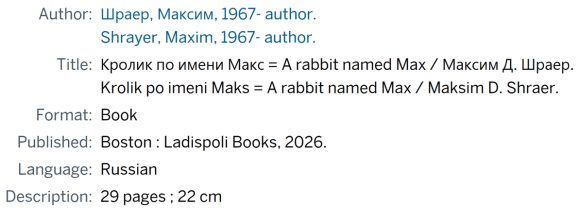
Screenshot of the library catalog record for the book, "Кролик по имени Макс," showing the Russian Cyrillic title and the Romanized form of the title, "Krolik po imeni Maks."

What are your local consortia requirements? If your institution is a member of a consortia, then your library’s catalog records may be subject to guidance provided by a consortia.

How has your institution configured it public catalog? Which description elements are keyword searchable, which are indexed? All integrated library systems and library management systems are configured locally based on the library’s needs. The same is true of public catalogs. It doesn’t hurt to learn about how your public catalog is configured: which descriptive elements are keyword searchable? Which elements are indexed? Does the title index include only the title and series title elements, or does the title index also include titles listed in the table of contents element?

Learning Cataloging

We’re reaching the end of our time and we’ve only just begun to sketch the faintest outline of the cataloging terrain. Before you dive into learning how to catalog, I hope you’ll pause to consider a couple of questions:

  • Who am I cataloging for? Who uses the collection?
  • How much cataloging have I been empowered to do? If I can’t do full-level cataloging to support robust discovery, is minimal-level cataloging sufficient to support known-item searching?

Once you have the scope of cataloging in mind, you may have a better sense of what training to attempt.

I’ve compiled a list of resources to help those new to cataloging get started.

Cataloging Wayfinding Resource List for Beginners and Learners

The list also includes resources that catalogers frequently consult in daily cataloging, discussion list recommendations, and online networking options.

Wherever you are on your cataloging journey, please know that there is a welcoming community that is eager to help! I’ve compiled some discussion lists and social media forums where you might merely ‘lurk,’ but don’t hesitate to ask a question or engage in conversation!

Thank you so much for your attention. I look forward to hearing your questions and experiences!

References

Cutter, Charles. Rules for a Dictionary Catalog. 4th ed., U.S. Government Printing Office, 1904. https://catalog.hathitrust.org/Record/001162739

Liss, Jennifer A. Cataloging Wayfinding Resource List for Beginners and Learners. 15 April 2026. https://bit.ly/cataloging-wayfinding

Categories
Meta

New Home

Same website, new URL! My portfolio has a new home:

jaliss.info

The old site is redirecting here and will continue to do so for some time. I’ve also added an SSL certificate and begun work on accessibility concerns. I’m by no means done.

I’m planning some content for the next couple of months. Ideas for posts include rewriting position descriptions for professional catalogers, impressions from a first-time ARLIS/NA conference attendee, and posting a faculty diversity statement.

Categories
Presentations

Using Core Competencies to Market Cataloging Expertise

I had a blast brainstorming how to advocate for cataloging and metadata operations in Indiana libraries! As promised, here is the Guide for Writing Core Competencies for Cataloging Positions.

Indiana Library Federation Annual Conference session participants shared many stories about how they explain what catalogers do. I captured notes from that discussion and included them in my slides (below). From those notes, I derived cataloging competencies. Those cataloging competencies include Research and Analytical reasoning–which is no surprise–as well as Judgement and Building trust. Building trust came up in the context of catalogers being trusted experts. Other stories showed that library users trust the authoritative information available to them in the library catalog.

My sincere gratitude to those who came to the session and shared their stories and ideas. I left feeling inspired and in awe of my fellow catalogers working in Indiana’s libraries.

Abstract

The Association for Library Collections & Technical Services (ALCTS), a division of the American Library Association, endorsed the document “Core Competencies for Cataloging and Metadata Professional Librarians” in March 2017. Whether you are a supervisor, a full-time cataloger, or someone who catalogs only under duress, core competencies can help you draw a direct correlation between quality cataloging and superior service. In this interactive session, participants will learn what core competencies are, how to use them in strategic planning and advocacy, and how to write core competencies that are appropriate for their own workplaces.

Slides

To view my speaker notes, view the presentation in SlideShare and click on the Notes tab.

https://www.slideshare.net/jenniferaliss/using-core-competencies-to-market-cataloging-expertise-and-get-stuff-done

Categories
Presentations

Cataloging Core Competency

I had a great time speaking about cataloging core competency at the Ohio Valley Group of Technical Services Librarians Annual Conference (slides and abstract below). I thoroughly enjoyed all of the stories and experiences that session participants shared.

Thank you, to all who attended!

Abstract

Linked data, RDA, and shelf ready processing are relatively recent developments in a long evolution of library technology, metadata standards, and technical services workflows. Although change has been a constant fixture of the cataloger’s reality, change is nonetheless disruptive—sometimes, bridges burn.

This session takes a historical view of cataloging and metadata creation from the time of Cutter to the dawn of semantic search. The evolution and interplay of technology, metadata standards, and workflows—the tools of our trade—will be considered. What were the roles of catalogers during times of transition? Which personal and professional strengths have proven invaluable over the last century? How does any of this help our community interpret developments in linked library data or user-centered resource discovery?

The presenter will propose a framework for interpreting changes in library technology, metadata standards, and technical services workflows. By viewing such changes through the lens of cataloging  core competency, our community might navigate into new territory and cooperate in the building of new bridges.

To view the speaker notes, open the presentation in SlideShare and click on notes.

http://www.slideshare.net/jenniferaliss/well-burn-that-bridge-when-we-get-to-ittechnology-metadata-standards-and-workflows-in-flux-competency-as-a-roadmap-through-uncertain-territory-62494137#notes-panel

Categories
Professional Development

Notes from ALA Midwinter 2015

The theme that jumped out at me at ALA Midwinter 2015 Meeting was the theme that I’ve been most engaged with in my recent work: the fundamentals. Fundamentals of cataloging, of metadata interoperability, of core competencies, of data models, and more. There were many moments during the conference when I thought, “Yeah, this is why I love what I do” and there were a few times when I thought, “Oh, there is a fundamental disagreement in how to accomplish task X–how will our community reconcile this in order to move forward?”

I returned to work excited and optimistic. However, without any post-conference recuperation time, I’m not too confident in my ability to write a cogent summary of my trip to blustery Chicago, so this post will be brief. Below are the highlights from selected programs I attended at ALA Midwinter 2015.

Note: there’s nothing here about the committees and interest group I’m serving on–I know, sorry, I was tweeting the heck out of those events. Once the ALCTS CaMMS Competencies and Education for a Career and Cataloging Interest Group [agenda] and the ALCTS/LITA Metadata Standards Committee [agenda] discussion summaries are posted, I’ll link to them (sign-in may be required).

FRBR Interest Group

  • An interesting debate that pretty much came down to: is FRBR dead yet? To which the rejoinder seemed to be, is RDA dead yet?
  • I think the tension lies in the FRBR model’s founding in the entity-relationship model (think relational databases) and the push to move library data to the linked web of data.
  • Conclusion: I need to learn more about FRBRoo. Looking into the efforts of the IFLA Working Group on FRBR/CRM Dialogue might be a good place to start.

Cataloging Norms Interest Group

  • Question: What would a catalog made by researchers look like?
  • Comment: Better cataloging tools. That is all.
  • Concern: Adding identifiers to MARC record authorized access points in a local database? There’s got to be a better way to scale linking work.

MARC Formats Transition Interest Group

  • BIBLFLOW project at UC Davis Library works to launch BIBFRAME support in Kuali OLE using Blacklight as a discovery layer. Presentation slides by Xiaoli Li.
  • National Library of Medicine is researching a BIBFRAME Core vocabulary, drawing upon the PCC BIBCO Standard Record and the CONSER Standard Record profiles. NLM plans to experiment with EAD and MODS mappings and work with Jackie Shieh to test the proposed BFcore vocabulary. Presentation slides by Nancy Fallgren.
  • The discussion revealed ideological tension in how BIBFRAME development should have proceeded. Some see BIBFRAME’s robust vocabulary as a deterrent to widespread adoption across multiple domain areas (music, audio-visual, archives, and cultural heritage communities). Others argue that robustness is needed in order for data to be semantically unambiguous and that reuse of existing vocabularies is too risky.

Linked Library Data Interest Group

  • Victoria Mueller [slides] described a BF/Schema.org strategy that games page ranking in order to push libraries to the tops of search results lists.
  • Nancy Lorimer [slides] gave an update on Linked Data for Libraries (LD4L); project is using various data sources: bibliographic information from MARC, MODS, and EAD sources; person/corporation data from VIVO, ORCID, ISNI, and VIAF; usage data from circulation statistics and citations; utilizes OCLC’s works identifiers; project continues to provide use cases for BIBFRAME and linked data and will result in the development of a Hydra head.

Library of Congress BIBFRAME Update

Although not yet posted, recordings of BIBFRAME Update sessions are eventually posted online: http://www.loc.gov/bibframe/media/.

  • Sally McCallum reported that LC has engaged a RDF expert to review BIBFRAME.
  • Beecher Wiggins revealed LC’s plan to launch a first phase of a BIBFRAME pilot in the spring: 25-30 LC staff will catalog a diverse set of languages/scripts and formats; staff will create a BIBFRAME record and a MARC record so that production factors may be evaluated.
  • Paul Frank was confident that the learning curve for learning to use the BF Editor would not be steep and that the true challenge would be figuring out workflows–for instance, where/how authority work would occur.
  • Nate Trail reported on LC’s efforts to build infrastructure to support BF:
    • LC has a contract with Smart Software Solutions to create a GUI for customizing (I think) the configuration of the BF Editor so that it is easier to create profiles (one profile for dissertations, one for streaming video, etc.).
    • LC has entered into a contract to get SRU ready for use on a triplestore.
    • LC was looking into using Fedora 4 with elastic search in order to power a BF search/display.
  • Phil Schreur (Stanford) reported on collaborative as well as in-house work in BF:
    • Reported on the very recent formation (first meeting was the prior day) of a cohort of six institutions that will cooperate in launching BIBFRAME at their institutions: Stanford, Cornell, Harvard, Princeton, Columbia, and the Library of Congress; the goal, according to Schreur, “Move toward production [of BIBFRAME] in some way, whatever that means.” Group will utilize the tools developed by LC, shared cloud space, and shared resource files (that is, BIBFRAME works and instances). Each institution would work in the context of its own ILS.
    • The work at Stanford will focus on realigning workflows; Stanford will target vendor-supplied bibliographic records that are handled by acquisitions staff and convert MARC to BF; original cataloging work will be completed entirely in BF–among the questions to work out are do they need to BF to MARC converter? how will they complete authority work? analyze a switch to FAST instead of LCSH (which doesn’t scale to the linked data environment); Stanford will also launch a domain-focused project to produce BF data for recorded performance music.
  • Ted Fons (OCLC) outlined a high-level strategy for increasing libraries and library data on the web: model things of interest to the web; make things available in structures familiar to the web (Schema.org); improve library workflows by improving discovery (how to do this wasn’t addressed) and reinventing cataloging (cataloging workflows certainly, not sure if Fons also meant reimagining cataloging policy). Fons cited the recently released white paper, Common Ground: Exploring Compatibilities between the Linked Data Models of the Library of Congress and OCLC [link].
  • Eric Miller (Zepheira) asserted that libraries must shift focus from creating data (minting URIs for vocabularies, etc.); to creating linkages, declaring relationships between data points.

Categories
Cataloging & Metadata

Researching Archival Photographs

I originally wrote this post for my personal blog, since I’d done this research purely for fun. Ultimately, the post landed on my professional blog, as it lends insight into certain aspects of the metadata work I do. If you like solving mysteries, learning about history, and using visual media to explore issues of race, gender, class, politics, and a whole lot more, read on.


A tweet led me to this photograph from the National Archives: Evelyn T. Gray, Riveter and Pearlyne Smiley, Bucker, Complete a Job on Center Section of a Bomber.

While scanning the image for clues that would identify the aircraft, I started to notice details about the women pictured. Where was this photo taken? Why does this photo seem to be telling a different story than the one this color transparency tells? Who took the photo? Were other photos taken at the same time—and were those photos also digitized?

Research & Metadata Creation

Whether you’re flipping pizzas or creating metadata, the art of doing any job well is figuring out aspects of the work that waste time and fail to lend value to the product. The most difficult pieces of information to obtain when researching archival photographs are the names of persons pictured and the provenance of the photograph. If these details are known, many other pieces of information fall into place. Place names are also incredibly helpful to know when chasing down facts about an image. Figuring out the one- to two-year span in which a photograph was taken may not be too hard, once other facts are known.

Given the information I already had available (the names of the persons pictured), figuring out the photographer’s identity was the first mystery to solve.

Getting to the Source Material

The first rule of image sleuthing is to seek out the original source, if possible. This is often not easy. There’s a long history (long before the internet) of people copying and using images without first obtaining permission or crediting the source/creator. Fortunately, Slate Vault’s tweet included a link to the institution that holds the original image. Seeing the physical artifact would have been optimal; however, the U.S. National Archives and Records Administration (NARA) in College Park, MD was a little far for a Sunday drive. From the comfort of my couch, I navigated to the image in NARA’s digital repository.

Know What You Know (and Know What You Don’t Know)

The next step in researching archival photographs is assessing the verity of the information provided with the photograph. Photographers are lousy spellers. Some misremember facts about who/where/what they were shooting. And some are flat out liars. Skepticism is encouraged. So what do we know for certain about this image?

Screencapture of the collection, series, and item titles

The information about this image is provided by NARA–a trustworthy source (your friend’s Facebook feed? Not a trustworthy source: keep digging!). This photograph that was created by the Women’s Bureau of the U.S. Department of Labor. Context is extremely important when evaluating individual archival items. The NARA record indicates that this photographic print is part of the collection, Women Working in Industry, 1940-1945. Other materials in this collection may provide clues as to where the photograph was taken.

Factory button worn by Pearlyne "North American Aviation D31, 214"

Had I not been so preoccupied by the bomber Evelyn and Pearlyne are working on, I would have looked at the series to find clues about location. However, there were a finite number of plants in the U.S. building bombers during WWII. Figuring out the make and model would dramatically narrow down the list of possible places that this photo was taken. On NARA’s digital collections website, I zoomed in on the photo to get a better look at Pearlyne’s worker badge: North American Aviation (NAA). Aha! NAA produced one bomber during the war. Evelyn and Pearlyne are working on a B-25 Mitchell assembly line. [1]

Only two North American Aviation plants built B-25s: NAA’s main plant in Inglewood, California, and a plant in Kansas City, adjacent to Fairfax Field. I had two possible locations and the names of both women in the photo. My next task was to play genealogist. [2]

Couch Genealogist

I’m not sure you can call what I do genealogical research (any Finding Your Roots fans?) but I’m a fair couch genealogist and I love testing how much a “novice” is able to find with modest resources. I started with the easiest thing I could do—search via Google. I tried two searches:

“evelyn t gray” California

“evelyn t gray” Kansas

At least a two Evelyn T. Grays lived in Southern California and were about the right age in the early 1940s. I would have found more Evelyns, had I searched without the middle initial. An Evelyn T. Gray lived in Kansas City during this period. I couldn’t find obituaries for any of these Evelyns via Google. At this point, I might have pursued Evelyn a bit more (the section called Finding Folk describes how I might have done this) but I had another person to research and Pearlyne is a far less common name.

I played the ‘what does Google know’ game with the quoted search, “Pearlyne Smiley.” Predictably, all of the search results referenced the image that I was attempting to describe. Searching “Pearlyne Smiley Inglewood” got me nowhere; however, searching “Pearlyne Smiley Kansas” retrieved a hit on Newspapers.com. Even better, there was OCR [3] of the text available!

OCR from Newspapers.com helped me find this photo in the January 1943 Pittsburgh Courier

I used the browser’s find function, to confirm that “NAA” and “Kansas” both appeared somewhere on this giant newspaper page (“Inglewood” had no hits; “California” had two). I can see from the thumbnail image that there are eight columns of text on the newspaper page. The OCR program read the page faithfully from left to right, which meant that the text of the article was garbled up with junk characters from images and SHOUTY ALL CAPS MESSAGES from advertisements. While the results I got were very encouraging, I needed to see the scanned image of the newspaper page for confirmation. I clicked on the View Full Page button and lo! A paywall. I could not access the high-resolution image.

Licensed Databases at Your Library

Where the not-so-open web had failed me, libraries came through. My institution (a Big Ten research library) pays for access to the ProQuest Historical Newspaper database. I found the newspaper page (nice interface, ProQuest) and, with the digitized newspaper page before me, I confirmed that this photograph was taken at the Kansas City North American Aviation plant. *throws confetti*

This confirmation also means that I can safely disambiguate the identity of Evelyn T. Gray of Kansas City from the other Evelyn Grays I found living in California around the same time. I used a couple of the sources listed below, under Finding Folk, to confirm that Evelyn was born in 1909 and died in 1999. She is buried in Chapel Hill Memorial Gardens in Kansas City. Confirmation of place means that I can now move onto refining the period in which this photo was taken.

Dating Photographs Using Primary and Secondary Sources

The challenge of narrowing the date range from 1940-1945 (as given to us from the name of the series to which this photo belongs) would require research. The photograph appeared in the Pittsburgh Courier on January 30, 1943. According to Wikipedia, the Kansas City plant began producing B-25s in December 1941—that makes for a 14-month span. Can I narrow this down? When did women begin working the line at the Kansas City plant?

In the course of verifying the location and employee demographics of the North American Aviation plant in Kansas City (a fascinating topic that deserves more research), I found a relevant article from the journal, Kansas History. The article by Richard Macias (see References below) is worth a read, as it provides contextual information about black workers and the war effort. The part that is relevant to dating this photo: women began training in factory production work in March 1942 (Macias 255). March 1942 to late January 1943: an eleven-month span.

Cover of North American Skyline July 1942

Here I got stuck. I found an online store/WWII digital archive containing Skyline, a magazine published by North American Aviation. According to this website, the July 1942 issue has an article with the title, “The Camera Looks at North American – Photographs from all the plants.” Was this article referencing the Women’s Bureau visit to the plant or was this a completely unrelated general interest piece? It’s a stretch. A quick search of WorldCat reveals that the Smithsonian holds this particular magazine; the Smithsonian catalog confirms that the specific issue is available. I could try to get a copy of this article through interlibrary loan but I’m sensing a dead end. Seeing the physical item held by NARA might help; however, it’s unlikely that useful information scrawled on the back of the photograph wouldn’t have been recorded in the catalog record when the photo was digitized. There may be other information in the series of archival materials in which this photo lives and that may be worth checking into if I’m ever in the area. There’s a good chance that this photograph was taken in late 1942.

Share the Love (Sharing Metadata)

Tags contributed to digital object

Metadata is a love note to the future, as Jason Scott (@textfiles) once said. If you’ve assembled some research about an image, share it! The National Archives encourages Citizen Archivists to add searchable tags to their digital collections. Social tagging is a different activity than the subject analysis that cataloging and metadata professionals engage in (a fine topic for a future post); both activities are useful for discovery, so I used both tags (what the photo is of) and terms resulting from subject analysis (what the photo is about).

I contributed the following tags, using a combination of terms taken from thesauri and natural-language terms that people are likely to use in a search: Women in war, Factory workers, Airplane factories, B-25 Mitchell, Kansas City (Kan.), “North American Aviation, Inc., of Kansas”, NAA, “Gray, Evelyn T., 1909-1999”, ca. 1942, World War II, WWII. The terms I chose and why I chose them (why “Factory workers” and not “Hairnets”?) are topics for another time.

The Work isn’t Done!

Feeling inspired? Disappointed/incensed that none of my tags addressed race (#blacklivesmatter)? Did you find Pearlyne’s birth and death dates?? [4] There’s plenty more to add to this and many other primary sources. Create an account at NARA and start tagging.

Finding Folk

For quick, “couch genealogy,” Ancestry.com is the resource to beat. However, Ancestry.com is pay-to-play. Fortunately, most public libraries pay for a subscription. If your library doesn’t provide access to Ancestry.com, head over to one of the many websites that search the Social Security Death Index. My favorite free-to-search option is GenealogyBank.com. You’ll receive the following information from search results: first, last name and middle initial; birth and death years; state of last residence; and state in which the social security number was issued. If you want to see more about a person in the results list, you’ll have to sign up for a subscription. Another free resource for finding dead people is findagrave.com.

Note though, that even official documents, such as birth/death certificates, marriage licenses, census records, service records, and yes, gravestones, are susceptible to error.

References

Department of Labor. Women’s Bureau. (1940-1945). Evelyn T. Gray, Riveter, and Pearlyne Smiley, Bucker, Complete a Job on Center Section of a Bomber. Records of the Women’s Bureau, 1892-1995. Retrieved from http://research.archives.gov/description/7452275

Female workers of North American Aviation, Inc., “Keep ’em flying”. (1943 Jan 30). The Pittsburgh Courier (1911-1950) Retrieved from http://search.proquest.com/docview/202146054 (log in required)

Macias, Richard. (2005). “‘We all had a cause’: Kansas City’s bomber plant, 1940-1945.” Kansas History, 28(4): 244-261. Retrieved from http://www.kshs.org/publicat/history/2005winter_macias.pdf


  1. B-25s were famously used by the Doolittle Raiders.
  2. I don’t do this type of research much but if you want to read more on my brand of ‘couch genealogy,’ see the section Finding Folk, at the end of this post.
  3. OCR, or Optical Character Recognition. Wikipedia has a decent explanation: http://en.wikipedia.org/wiki/Optical_character_recognition.
  4. I didn’t add Pearlyne’s name because I didn’t have anything unique to add that wasn’t already in the catalog record.
Categories
Professional Development

DC-2014 Conference Highlights and Reading

Good programs at the International Conference on Dublin Core & Metadata Applications–my thanks to all of the folks who organized, sponsored, presented, and attended. My notes are a mess but I pulled together some take-aways, with a few news items summarized eloquently by other DC-2014 attendees. For my own future reference, I’ve included a list of papers that I look forward to reading.

Conference Highlights in Brief

The most urgent work ahead for DCMI and the library metadata community at large: defining BIBFRAME Profiles. Early implementers are testing prototype profiles but more work is needed.

RDF validation is another high priority. I’m certain now that I should have braved one of the special sessions on RDF Application Profiles, even if the finer details would have been lost on me. Also, because this:

OCLC & Friends continue to forge ahead with Schema.org. The Schema Bib Extend W3C Community Group has made considerable headway, proposing numerous changes to Schema. It has also released an extension for Schema.org, BiblioGraph.net. The implications of libraries devoting scarce resources to a commercially-supported standard were discussed in realistic terms; doubts and reservations were readily acknowledged.

Zepheira is offering linked data/BIBFRAME training for practitioners. Stanford announced its BIBFRAME plans:

Succession planning is making way for re-envisioned positions and new opportunities at Princeton, where initial BIBFRAME testing has been performed and BIBFRAME pilot projects will begin in the next calendar year.

And we discovered that we all harbor a love-hate relationship with FRBR:

DC-2014 Conference Paper Reading List

I didn’t attend these sessions; however, they inspired intriguing back channel chatter. My post-conference to-read list, in no particular order:

The full proceedings are already available. Presentations will be posted soon.

Categories
Professional Development

ALA Annual 2014 Follow Up Notes

I have an extraordinary number of browser tabs open, which must mean the ALA Annual 2014 Conference is over. I escaped Vegas as quickly as possible and I’ve been traveling the west (the National Park Service? THE BEST). I’ve been jotting down notes on ALA Annual 2014 that I’ll record here.

The Takeaway

BIBFRAME. Are you in? WHY AREN’T YOU IN???

I learned bunches more about microdata. The Understanding Schema.org session was great. Dan Scott and Jason Clark have GOT THIS. See the session’s description and links to presentation slides. Highly recommended. I look forward to future discussions with my discovery folks.

In the realm of not-metadata, the LLAMA President’s Program, “Leaders as Followers: You don’t have to be in Charge to be a Leader” presented a management philosophy akin to one I’ve been trying to live for the last year. Carrie Messina pushed staff empowerment to the extreme through institutionalized storytelling. Lots to think about from this meeting. I can’t change the entire culture of the library but I can change the culture of my own cataloging unit…

Follow Up

There are countless sessions I will need to catch up on. I had to miss every big BIBFRAME session due to one service commitment or another.

Presentations

I gave two presentations at ALA Annual, one on competencies for catalogers, the other on authority data for a linked data future (co-presented with Indiana’s PCC Coordinator). I have lots of notes, comments, and follow up questions to think through–maybe I’ll post them here at a later date. I’m so grateful to everyone who shared their ideas with me!

Categories
Management

Policy impact

Annual report time looms. A couple of weeks ago, I did some statistical prep work (hello, spreadsheets!) to help get things rolling. One particular statistical trend stood out.

The chart below (click to enlarge) represents the percentage of new authority records I created versus existing authority records I edited in the second half of 2011 and in the years 2012 and 2013. Quite a turn around, eh?

Three pie charts depicting the following: 97% of NACO work being devoted to creating new authority records and 3% of NACO work being devoted to editing existing name authority records from July-December 2011; 68% of NACO work being devoted to creating new authority records and 32% of NACO work being devoted to editing existing name authority records in 2012; and 33% of NACO work being devoted to creating new authority records and 67% of NACO work being devoted to editing existing name authority records in 2013.

At the end of September 2012, I trained in RDA cataloging for print books. At that time, the Cataloging Division adopted a new policy for authority work performed by original catalogers: ALL authorized access points appearing in bibliographic records coded RDA must have accompanying name authority files coded RDA.

The number of new NACO records I created didn’t go down (that number actually increased); the number of NACO edits to existing authority records skyrocketed. After enacting the new authority work policy, my average monthly NACO contributions increased by 310%.

The line graph shows how the number of created records and edited records fluctuated over time. A general fall in NACO statistics in August-September and in November reflects my transition into a new job and preparations relating to our section head’s retirement, respectively.

A line graph demonstrating marked rise in the number of edited authority records via NACO program after September 2012.

Hashing out the pros/cons of this particular policy change is beyond the scope of this post. The immediate takeaway for me: policy changes can have big consequences, the kind that inspire fist pumps or headdesks. Having a way to measure the impact of a change on timeliness and productivity–before the change is made–is fairly critical. Judging the impact of a policy or procedural change on the overall value of service seems significantly harder.

Categories
Research

Just words

I thought I’d post a Wordle from a report I wrote recently.The report is the result of a couple weeks of collaborative brainstorming with four colleagues concerning the future of library authority data. Going through the brain acrobatics of imagining a recordless linked data environment that weaves together authority and bibliographic data was surprisingly enjoyable. In retrospect, I realized that I consistently used the phrase “authority data” rather than “authority metadata.” One person’s metadata is another person’s data I suppose. <stale NSA joke omitted/>

Wordle generated from a recently written report

On my writing list before the end of the year: cataloging policy and procedure and then my annual report. It’s a good thing I’m finally feeling better. Writing with medicine head and little sleep is no fun at all.